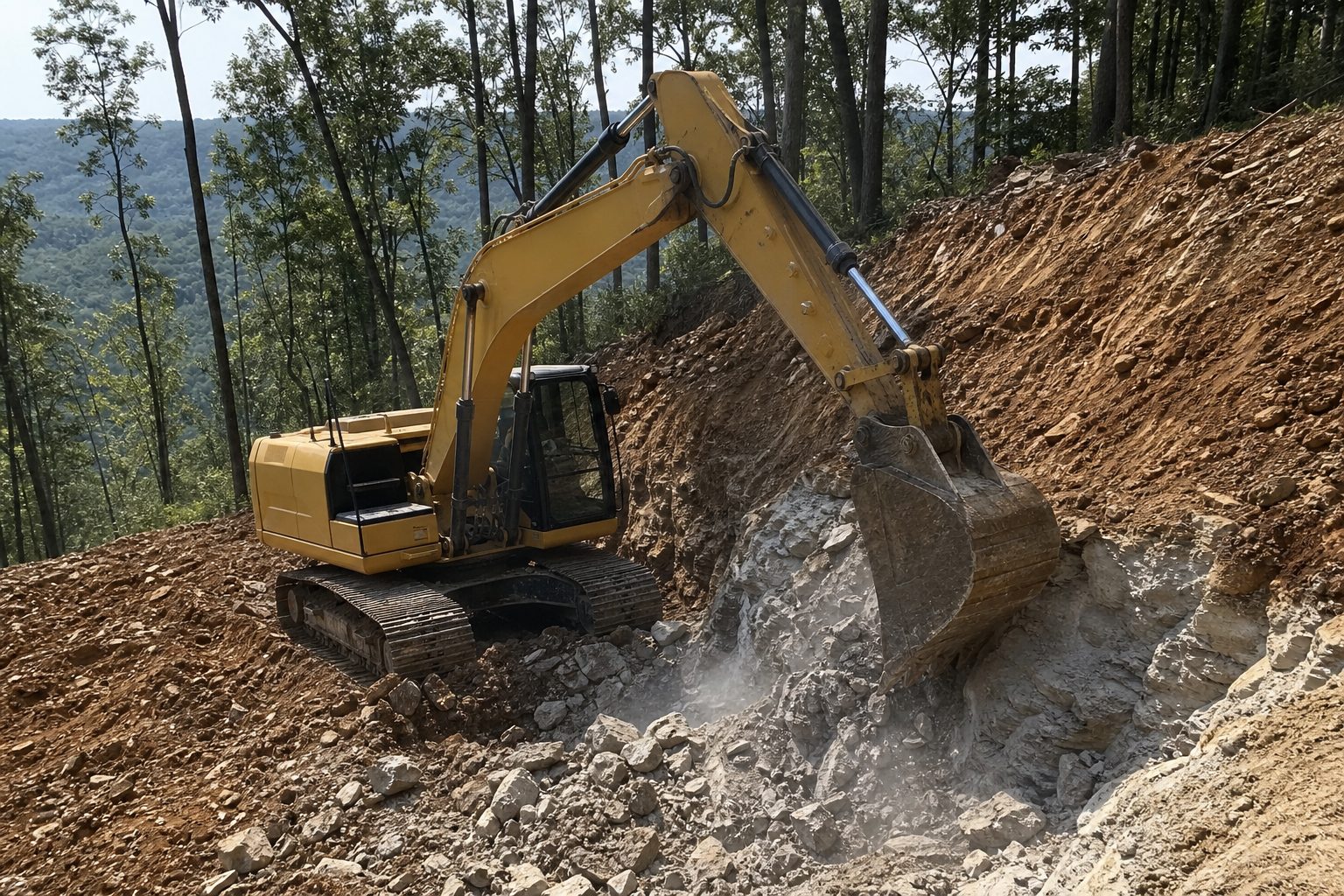
Some of the most beautiful building sites in East Tennessee are also the most expensive to develop, and the reason is usually somewhere under your feet. Rock, slope and thin soil are the defining features of the Cumberland Plateau and the ridges around it, and they have more effect on an excavation budget than almost anything else.
We do not avoid these sites. We work on them regularly. But we would rather tell a landowner what they are dealing with before the machines show up than have that conversation in the middle of the job.
Rock Is the Big Variable
On a lot with several feet of workable soil, excavation is predictable. A machine digs, the material moves, and the work goes about as fast as you would expect. On a lot with rock within a foot or two of the surface, that same work turns into something else entirely.
Shallow rock affects nearly every part of a project:
- House pads and footers. Footings have to reach solid, uniform bearing. Cutting into ledge takes time, specialized attachments and more machine hours.
- Utility trenching. Sewer, water and electric lines need a minimum depth and a proper bedding material. Rock in the trench line means breaking, hauling and importing bedding stone.
- Septic. This is often the deciding factor. Conventional drain fields need soil depth below the trench. Where rock sits shallow, the system moves to a shallower or alternative design, which changes the price significantly.
- Driveways. Ironically, rock can help here. Solid material makes a good base. But cutting a driveway through a rock shelf to reach a buildable bench is its own project.
The hard part about rock is that it is not uniform. A property can have eight feet of soil at the road and eighteen inches of soil at the house site. Test pits and soil evaluation are how you find that out before it becomes a change order.
Slope Costs More Than People Expect
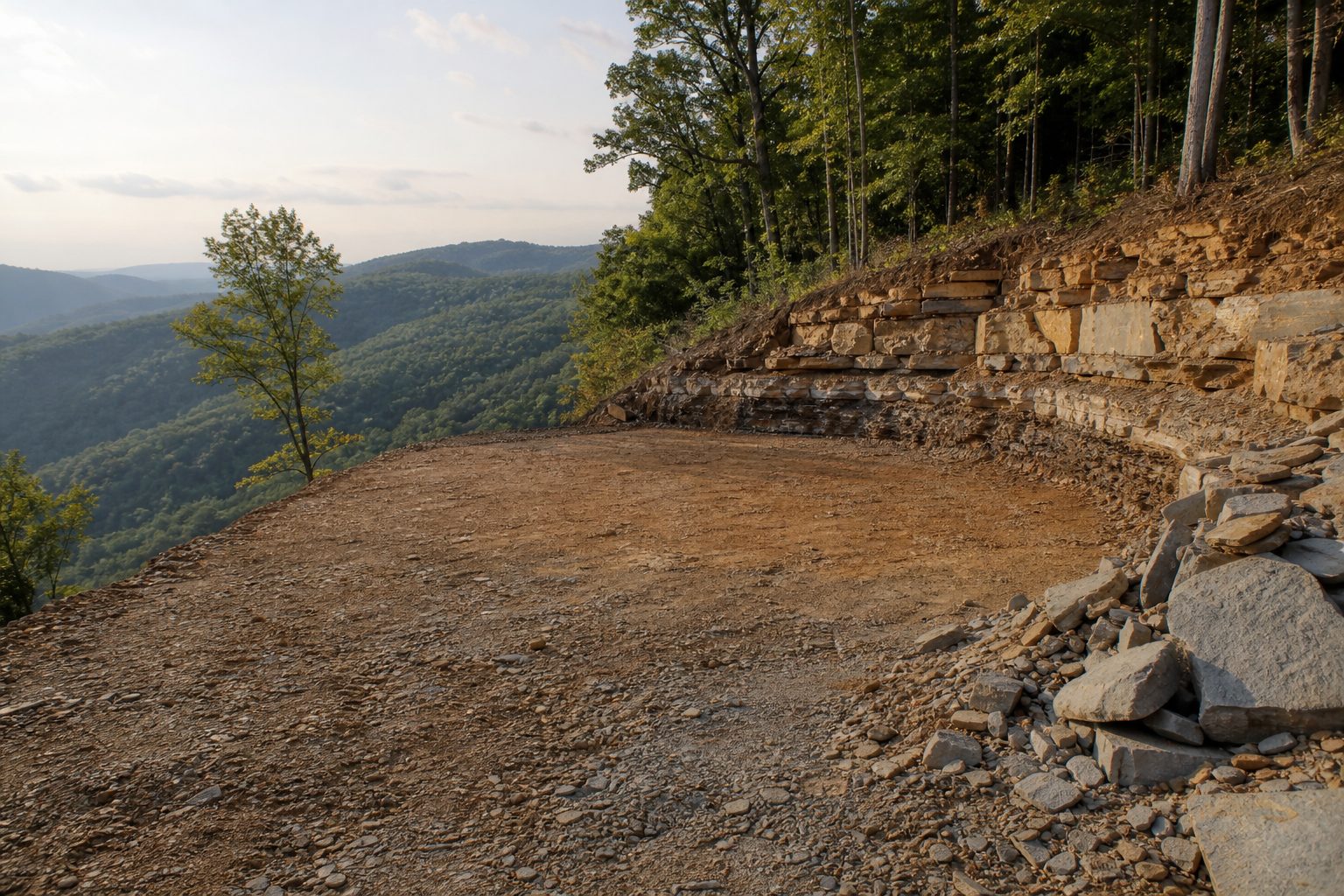
A sloped lot means cut and fill. To create a level building area you have to cut into the hill on the uphill side and place that material on the downhill side, and the steeper the grade, the more material has to move to get the same size pad.
Slope also brings requirements that flat ground does not:
- Retaining structures. A cut face above a certain height needs to be held back, whether with a block wall, a boulder wall or a stepped bench.
- Compacted fill. Fill placed on the downhill side of a pad has to be placed in lifts and compacted properly. A pad that is half native ground and half poorly placed fill will settle unevenly, and the structure on top of it will show it.
- Drainage. Everything upslope of your house eventually runs past it. Diversion swales, culverts and drainage behind retaining walls are not optional on hillside sites.
- Access. Machines and concrete trucks have to reach the work. On steep property the access road is sometimes the first real expense of the project.
Thin Soil and Where the Dirt Comes From
Plateau and ridge sites often have very little topsoil. That matters at both ends of a project. At the start, there may not be enough usable material on site to build the pad, which means importing fill and paying to haul it in. At the end, there may not be enough topsoil to establish grass on the disturbed areas, which means importing that too.
Conversely, if you are cutting into rock, you may end up with more material than you can use and need somewhere to put it. Either way, hauling is a real line item, and haul distance on rural plateau roads is not trivial.
What Actually Drives the Price
When we look at a difficult site, these are the questions that move the number the most:
- How deep is the rock, and over how much of the work area?
- How much elevation change is there across the building area?
- Can a full-size machine and a loaded truck physically get to the work?
- Does the site balance, or do we have to import or export material?
- What does the septic design look like given the soil depth?
- Where does surface water come from and where does it need to go?
Notice that none of those can be answered from a road frontage photo or a phone call. That is why we walk sites before quoting them.
How to Protect Yourself as a Buyer
If you are considering buying rural land on the Plateau or on a ridge, a few steps will save you a great deal of money and frustration:
- Get the septic question answered before closing. A lot that cannot support a permitted system is a very different asset than one that can.
- Have someone walk the site with you who digs for a living. Rock outcrops, seeps, wet-weather springs and unstable fill are all visible to a trained eye.
- Look at access honestly. A driveway that has to climb 200 feet of elevation is a project, not a detail.
- Budget a contingency. On rocky ground, even a careful estimate has more variance than it would on flat farmland.
We Will Tell You Straight
We are transparent about the costs and challenges of working on difficult Plateau sites, including when the honest answer is that a site will be expensive. That is not a sales tactic. It is the only way this works for either of us, because a surprise halfway through the job is worse for the homeowner than a hard number at the start.
If you have a rocky or steep site anywhere in Loudon, Roane, Knox, Anderson, Morgan, Monroe, Blount, McMinn, Meigs or Sevier County, get in touch with Clear Flow Services and we will come look at it and tell you what you are really working with.