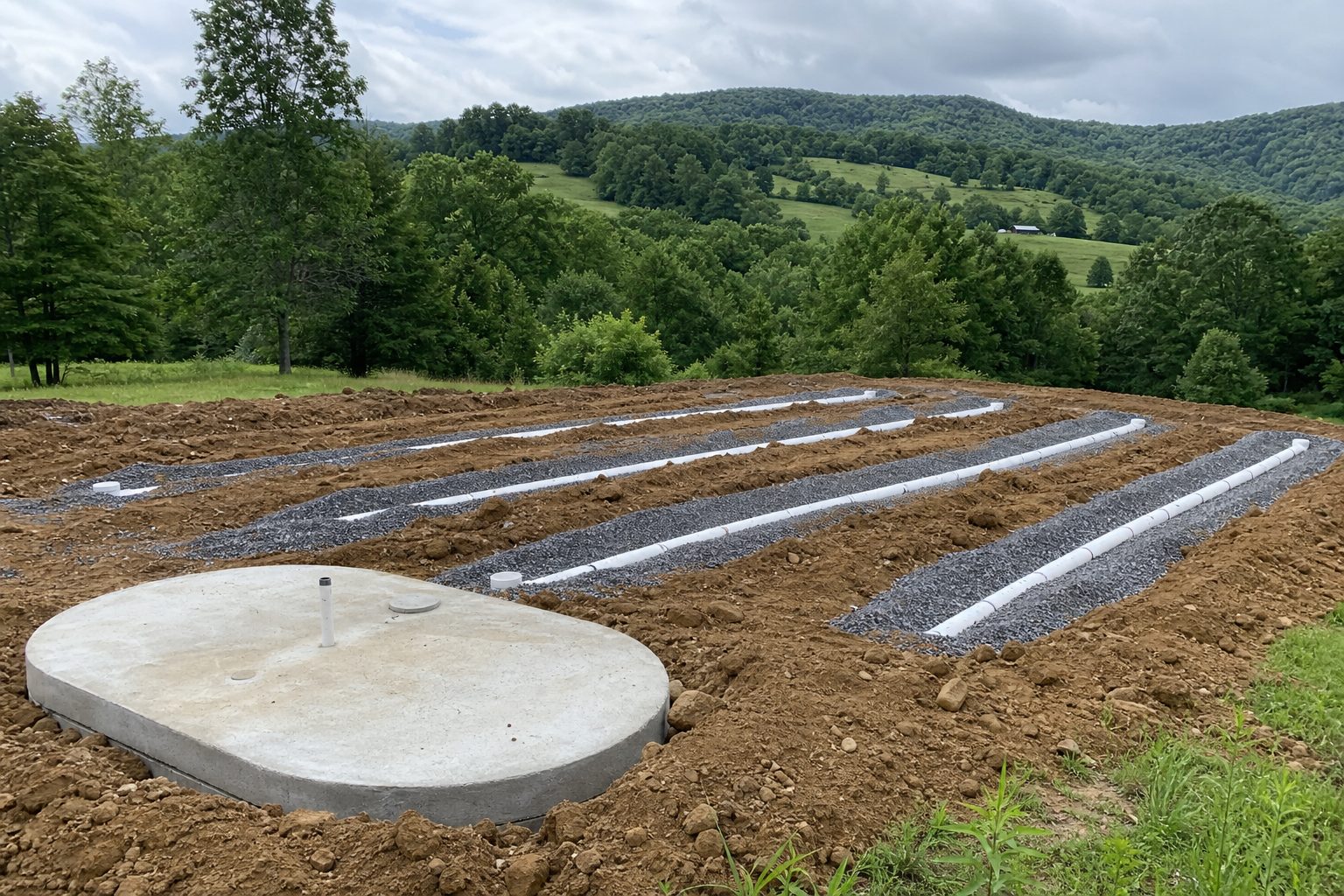
When homeowners in Loudon, Roane, Knox or Anderson County start pricing a septic system, they usually assume there is one kind of system and one price. There isn't. Tennessee recognizes several categories of subsurface sewage disposal system, and which one your property gets is not really your choice. It is determined by your soil, your lot, and what the state will permit.
Understanding the differences up front makes the whole process less frustrating, because it explains why two neighbors on the same road can get wildly different quotes.
The Conventional System
A conventional system is the baseline: a septic tank where solids settle out, followed by a gravity-fed drain field of trenches that release the clarified liquid into the soil for final treatment. No pumps, no electricity, no moving parts beyond the tank itself.
It is the least expensive option and the most durable, precisely because there is so little to break. When a lot has enough depth of suitable, well-drained soil and enough usable area, this is what gets permitted and this is what you want.
The catch is that plenty of East Tennessee lots do not have that soil. Shallow rock, heavy clay and steep slope are all common here, and any one of them can rule out a conventional system.
Low Pressure Pipe (LPP) Systems
When soil depth is limited, a Low Pressure Pipe system is often the next option Tennessee allows. Under the state's alternative system rules, an LPP differs from a conventional system in a few key ways: the effluent is pumped rather than gravity-fed, it is distributed under low pressure through a network of small-diameter pipes, and the trenches are placed shallow rather than deep.
That shallow placement is the whole advantage. The upper soil horizon is usually the most permeable and most biologically active soil on the lot, so an LPP can work on sites where there simply isn't enough depth above rock or a seasonal water table for a conventional trench.
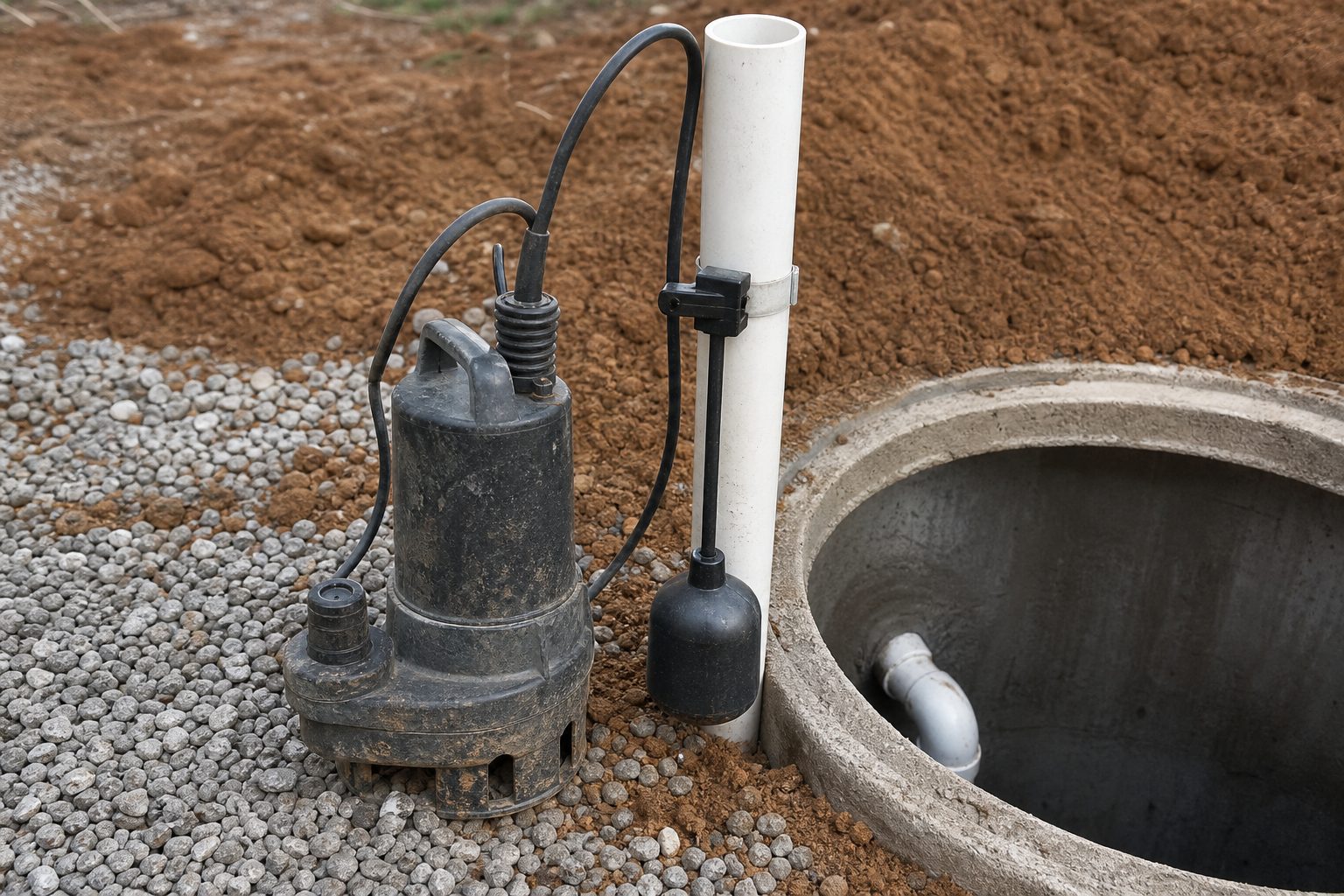
The trade-off is that an LPP has a pump tank, a pump, and controls. That means electricity, and it means components that eventually need service.
Mound Systems
A mound system is exactly what it sounds like: rather than putting the absorption area in the native soil, suitable fill material is brought in and the system is built above the natural ground surface. Effluent is dosed up into the mound, treated as it moves through the sand fill, and then dispersed into the soil below.
Mounds are used where the native soil is too shallow, too tight, or where the water table is too high for anything else. They cost more because you are buying and placing engineered fill, and they take up more room.
Drip and Other Alternative Systems
Beyond LPP and mound, Tennessee's rules provide for other alternative methods, including drip dispersal, where treated effluent is metered out through shallow tubing with small emitters across a wide area. These systems are the most flexible on difficult ground and the most equipment-intensive.
Design flow matters here. Under Tennessee's alternative system rules, wastewater flow for a residence served by an alternative method is calculated at 150 gallons per bedroom per day, and systems above 750 gallons per day are treated as large alternative systems with additional design and engineering requirements. In practice, that means bedroom count is one of the first things that changes your system size and your cost.
So Which One Will You Get?
The honest answer is that the soil decides. The sequence looks like this:
- Soil evaluation. Someone has to look at what is actually under your lot: soil depth, texture, drainage, restrictive layers, depth to rock.
- System selection. If the soil supports a conventional system, that is what gets designed, because it is cheaper and simpler. If it doesn't, the design moves to LPP, mound, or another alternative.
- Permit. The state reviews the proposed system against the site conditions and issues the construction permit.
- Installation and inspection. The system is installed to the permitted design and inspected before it is covered.
Anyone who quotes you a septic system before knowing what the soil looks like is guessing. That is why our first step is always to get out to the property.
What This Means for Your Budget
Conventional is the cheapest. LPP costs more because of the pump, tank and controls. Mound costs more again because of the imported fill and the size of the structure. Drip and other advanced systems sit at the top because of the treatment and dosing equipment involved.
Alternative systems also carry higher state permit and inspection fees than conventional ones, and if the system is large enough to require engineered design, that is an additional cost. None of these are reasons to be discouraged. They are reasons to find out what your lot needs early, before you have committed to a house plan or a closing date.
Maintenance Differs Too
A conventional system needs periodic pumping and not much else. Any system with a pump, controls or a treatment component needs regular attention: checking the pump and floats, verifying the alarm works, servicing filters. If you end up with an alternative system, budget for that upkeep from day one. Ignoring an alarm on a pumped system is how a small service call becomes a large repair.
Find Out What Your Lot Needs
If you are buying land, building, or replacing a failed system in Loudon, Roane, Knox, Anderson, Morgan, Monroe, Blount, McMinn, Meigs or Sevier County, the smartest thing you can do is get the site evaluated before you make plans around it. We will walk the property, tell you what we think the soil will support, and give you a straight answer about which system type you are realistically looking at.
Request a free quote from Clear Flow Services and we will get out to your site, usually within the week.