In East Tennessee, almost nothing is flat. That is what makes the property here worth owning, and it is also why so many homeowners spend money twice: once on landscaping, and again on fixing the water problem that ruined it.
Water always wins eventually. The goal of drainage work is not to stop it but to decide where it goes before it decides for itself.
How Sloped Lots Actually Fail
The symptoms show up in a predictable order.
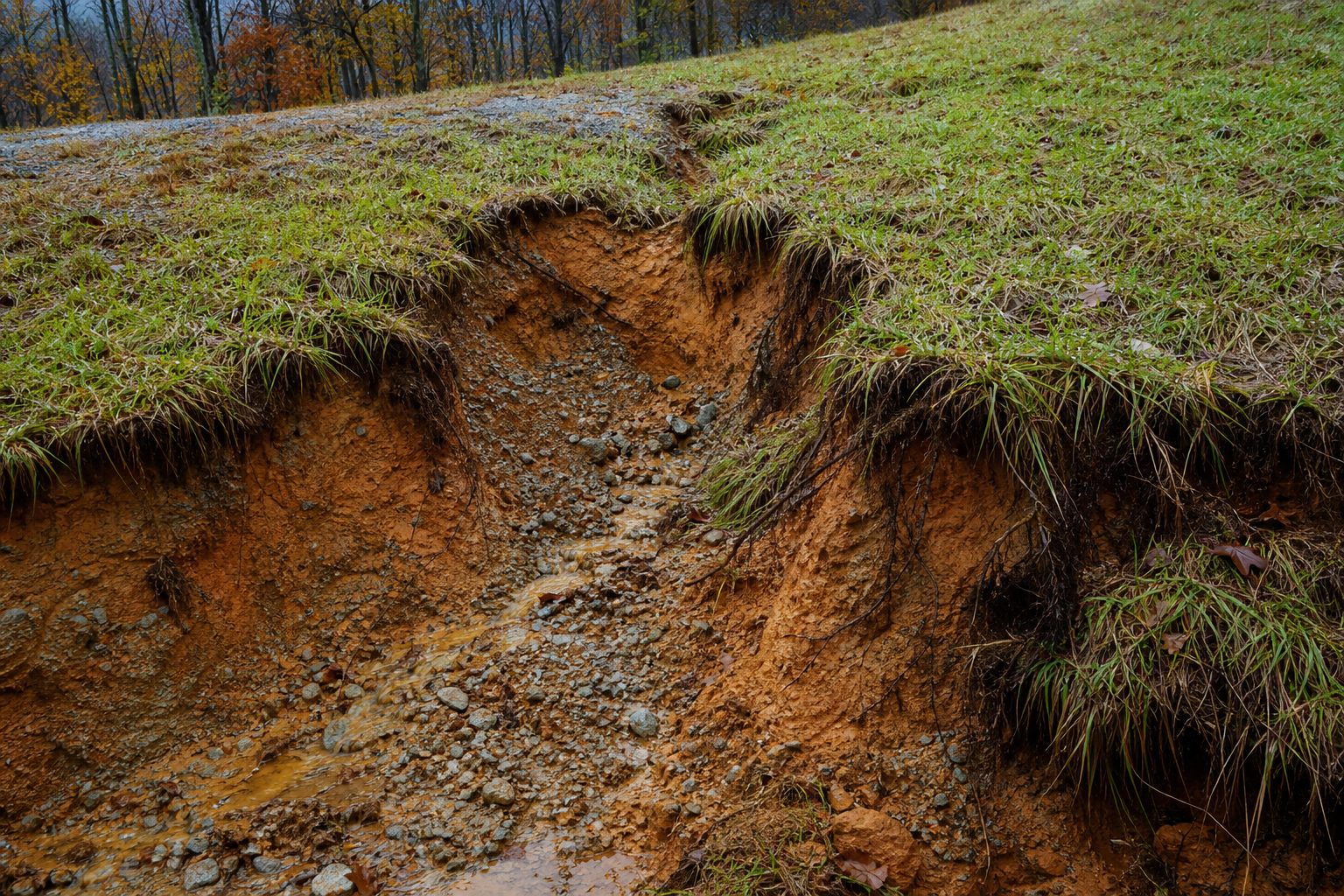
- Erosion channels. Small rills form on bare or thin-grassed slopes, then deepen with every heavy rain until they are gullies.
- Water against the foundation. Ground that slopes toward the house, or a flat area right at the wall, sends runoff exactly where you do not want it.
- A wet spot that never dries. Usually where a slope flattens out, or where a seep or wet-weather spring surfaces. Common on hillside lots here.
- Driveway washouts. Gravel drives on grade act as channels. Without a crown and side drainage, every storm carries material downhill.
- Downstream complaints. Concentrating your runoff and dumping it onto a neighbor creates a different kind of problem.
Start With Grade, Not Pipe
The instinct is to install a drain. Often the real fix is shaping the ground. The soil immediately around a house should fall away from the foundation, and swales, gentle shaped channels, can carry surface water around a structure and off to a safe outlet without any pipe at all.
Grading solves problems permanently and does not clog, which is why it should always be the first thing considered. Pipe is a tool for the water that grading cannot handle by itself.
When a French Drain Is the Right Answer
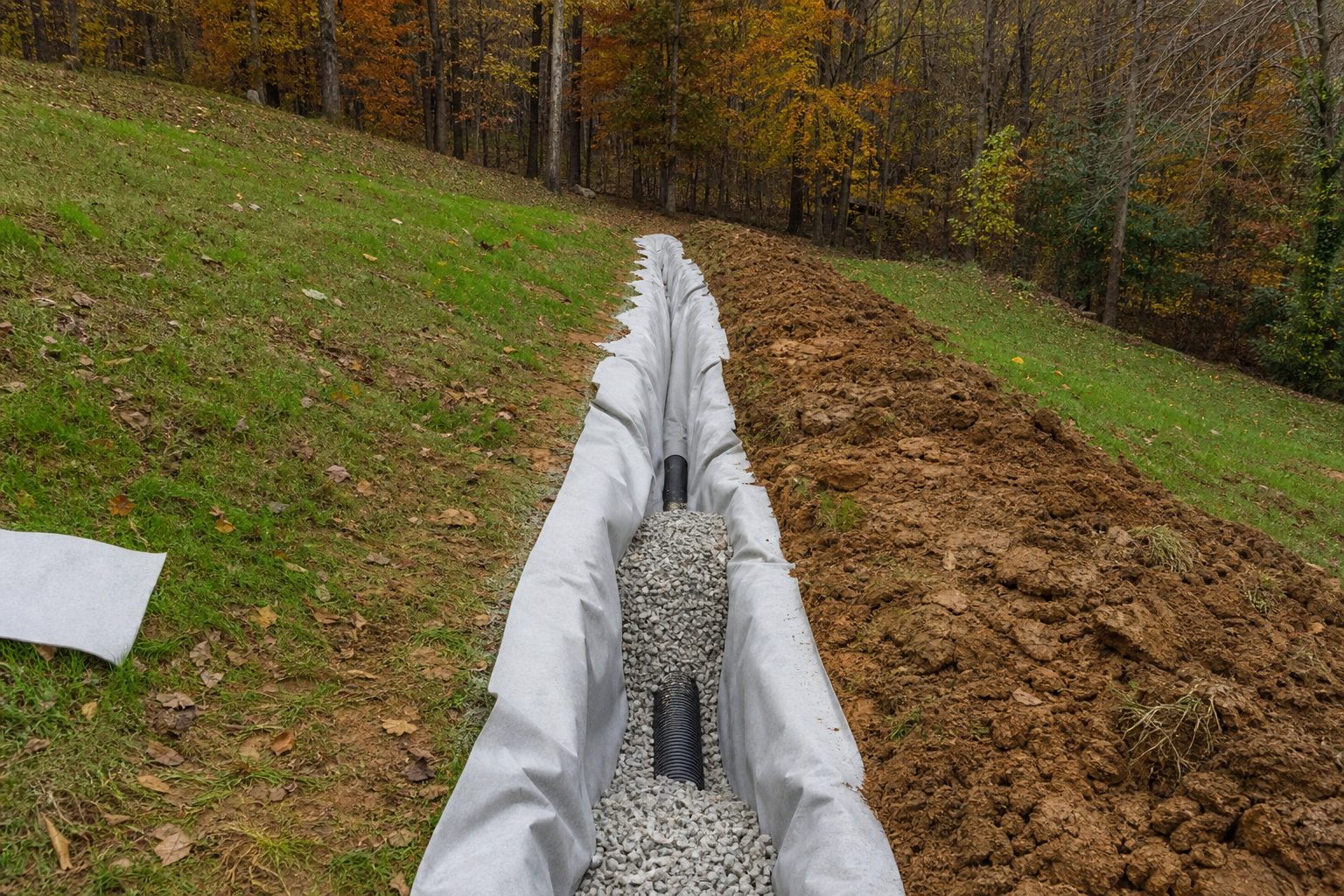
A French drain, a trench with filter fabric, perforated pipe and clean drainage stone, is for subsurface water: a seep, a persistently saturated area, or water moving through soil toward a basement wall. Done properly it works for decades. Done poorly it silts up and quits.
Three things make the difference:
- Fabric. Without it, soil migrates into the stone and the drain slowly fills.
- Clean stone. Washed drainage stone, not crusher run. Fines defeat the purpose.
- A real outlet. A drain must daylight somewhere lower, or discharge to a proper structure. A drain that runs to nowhere just relocates the puddle.
On a sloped lot, that third point is the easy one, which is one of the few advantages of hillside property.
Curtain Drains and Uphill Interception
The most effective drainage on a hillside lot often sits well above the house. A curtain or interceptor drain runs across the slope upgrade of the structure and catches water moving downhill before it ever reaches the building envelope. Handling water 60 feet uphill is far cheaper than fighting it at the foundation wall.
This is also the approach to consider when a septic field is downslope of a wet area, since keeping surface and shallow subsurface water off a drain field extends its life.
Erosion Control on Bare Slopes
Any newly disturbed slope is vulnerable until vegetation takes hold. Depending on steepness, that might mean seed and straw, erosion control blanket, riprap in a channel that carries concentrated flow, or terracing and retaining walls where the grade is simply too steep to hold cover.
Retaining walls do double duty here: they hold the grade and, when built correctly with drainage stone and a drain line behind them, they manage the water in the bank. A wall built without that drainage will lean or fail, because saturated soil behind a wall is enormously heavy.
Culverts and Driveways
Rural driveways cross drainage more often than people realize. A properly sized culvert at a low crossing, ditches that carry water off the drive rather than down it, and a crowned surface that sheds to both sides are what keep a gravel driveway from becoming an annual repair. Undersized or crushed culverts are one of the most common problems we find on older rural properties.
Why Fall Is the Time to Do This
Working ground in fall has real advantages. Soil is typically drier and easier to shape than in spring, which means better compaction and less mess. Vegetation is dying back, so disturbed areas are less disruptive. Most importantly, you get the work done ahead of winter rain and the spring thaw, which is when drainage problems do their damage.
Wait until you are standing in the problem in February and the fix is harder, messier and more expensive.
Get It Looked At Before Winter
If your yard holds water, your basement or crawlspace gets damp, your driveway washes out, or a slope on your property is visibly eroding, those problems do not stabilize on their own. They compound.
We handle grading, drainage, French drains, retaining walls and site work across Loudon, Roane, Knox, Anderson, Morgan, Monroe, Blount, McMinn, Meigs and Sevier counties. Request a free quote and we will walk the property, follow the water, and tell you what it will take to fix it properly.